Engineered fill provides stable support for buildings, roads, retaining walls, and utilities. Learn what engineered fill is, how it differs from ordinary fill, and why proper installation and testing matter.
Quick Summary
Engineered fill is not a special type of dirt. It is approved material that has been selected, placed, moisture conditioned when necessary, compacted in controlled lifts, and tested to meet engineering requirements.
Whether the project involves a commercial building, roadway, retaining wall, utility trench, or residential foundation, engineered fill helps create a stable base capable of supporting the finished structure for years to come.
Understanding engineered fill helps contractors, developers, and property owners avoid costly foundation problems and build with greater confidence.
What Is Engineered Fill?

Many people believe engineered fill is a special material that can only be purchased from a quarry or material supplier. While some projects require specific materials, the term “engineered fill” actually describes a construction process rather than a single product.
Engineered fill is material that has been approved by the project’s engineer and installed according to specific construction standards. Those standards typically require the material to be placed in controlled lifts, compacted to a specified density, moisture conditioned when necessary, and verified through field testing.
The same load of fill dirt delivered to two different projects could be considered ordinary fill on one job and engineered fill on another. The difference is not necessarily the material itself. The difference is how the material is specified, installed, and tested.
That distinction is one of the most misunderstood concepts in earthwork construction.
Why Do Engineers Specify Engineered Fill?
Every structure depends on the soil beneath it. If that soil settles after construction is complete, the structure above it may also settle. Cracked foundations, uneven floors, damaged utilities, pavement failures, and retaining wall movement often begin with poor soil preparation.
Engineers specify engineered fill because it provides predictable performance. Instead of relying on unknown soil conditions, they create a controlled foundation capable of supporting the design loads expected throughout the life of the structure.
Properly installed engineered fill helps:
- Reduce settlement
- Improve bearing capacity
- Create uniform support
- Improve long-term stability
- Reduce future maintenance
- Meet engineering and building code requirements
Although engineered fill requires additional planning and testing, it often prevents far more expensive repairs later.
What Materials Can Become Engineered Fill?
There is no single material called engineered fill. Instead, engineers select materials based on the requirements of each project.
Common materials include:
- Structural fill
- Select fill
- Crushed stone
- Gravel
- Sand
- Processed recycled concrete
- Recycled aggregate
- Approved native soils
Each material has different engineering characteristics. Some provide excellent drainage. Others offer high bearing capacity. Some compact extremely well. Others may only be suitable for specific applications. The engineer determines which material satisfies the project requirements based on laboratory testing, soil reports, and structural design.

How Is Engineered Fill Tested?
Testing separates engineered fill from ordinary fill placement. Engineers rely on laboratory and field testing to verify that the installed material performs as intended. One of the most common laboratory procedures is the Proctor test. This test determines the maximum dry density and optimum moisture content for a particular material. During construction, field technicians perform density testing on individual lifts.
Depending on the project specifications, many projects require at least 95 percent of the maximum dry density established by the Proctor test. If a lift fails testing, additional compaction or corrective work may be required before construction continues. Testing provides documented proof that the engineered fill meets the engineer’s specifications rather than relying on appearance alone.
Engineered Fill vs. Traditional Fill
Traditional fill is often placed simply to raise elevations or fill low areas.
While traditional fill may perform adequately in some situations, it is generally not installed under the same level of engineering oversight.
Engineered fill follows documented procedures for:
- Material approval
- Lift thickness
- Moisture control
- Compaction
- Field testing
- Quality assurance
Because of this controlled process, engineered fill provides much more predictable long-term performance.
Common Uses for Engineered Fill
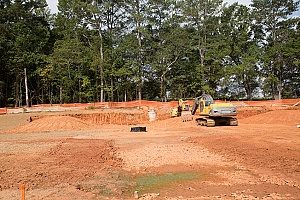
Engineered fill is used throughout the construction industry wherever stable soil conditions are required.
Common applications include:
- Building foundations
- Commercial building pads
- Residential foundations
- Roadways
- Highways
- Bridge approaches
- Utility trenches
- Parking lots
- Warehouse slabs
- Retaining walls
- Airport construction
- Data centers
- Industrial facilities
- Pool removals requiring future construction
Any project supporting significant structural loads may require engineered fill.
Common Mistakes When Using Engineered Fill
Many earthwork failures can be traced to improper installation rather than poor material quality.
Common mistakes include:
- Placing lifts that are too thick
- Compacting material that is too wet
- Compacting material that is too dry
- Skipping density testing
- Using unapproved materials
- Failing to prepare the existing subgrade
- Assuming all fill dirt performs the same
Even quality material can fail if it is installed improperly.
Contractor Tip

One of the biggest misconceptions is that engineered fill is something you purchase. In reality, engineered fill is usually something you create by following engineering specifications. The engineer approves the material. The contractor installs it correctly. The testing agency verifies that it meets the required density. Those three steps work together to produce engineered fill capable of supporting long-term construction.
Frequently Asked Questions
What is engineered fill?
Engineered fill consists of approved material that contractors place in controlled lifts, compact to the required density, adjust for proper moisture when necessary, and verify through field testing to satisfy engineering specifications.
Is engineered fill the same as structural fill?
No. Structural fill is one type of approved material engineers may specify for a project. The term refers to the installation process—including proper placement, compaction, and testing—rather than a specific type of soil or aggregate.
Why is density testing important?
Density testing verifies that contractors compacted the installed material to the level required by the project engineer. Proper compaction helps reduce future settlement and improves long-term structural performance.
Can native soil become engineered backfill?
Yes. Native soil may serve as engineered backfill if it meets the project specifications, receives engineering approval, and contractors install and compact it according to the required standards.
Is engineered compaction required on every project?
No. Project size, soil conditions, local building codes, engineering requirements, and the intended use of the site determine whether controlled fill placement and compaction are necessary.
Final Thoughts
Engineered fill plays a critical role in modern construction by providing stable, predictable support for the structures built above it. Although many people focus on the visible parts of a project, long-term success often depends on the work completed below the surface.
Proper material selection, controlled placement, moisture management, compaction, and testing work together to create a foundation capable of supporting buildings, roads, retaining walls, and other infrastructure for decades.
Understanding this construction method helps contractors, developers, engineers, and property owners make better decisions before construction begins, reducing risk while improving long-term project performance.
Dirt Connections Network (DCN)
Construction professionals often need reliable connections just as much as they need quality materials. Dirt Connections Network (DCN) is a private construction marketplace where contractors, suppliers, truckers, developers, and other construction professionals connect directly to discover projects, material opportunities, trucking needs, and business relationships throughout the United States and beyond.
Dirt Connections Public Listings (DCPL)
If you are looking for available fill dirt, topsoil, aggregates, or need to locate material for an upcoming project, Dirt Connections Public Listings (DCPL) provides a searchable public platform where homeowners, contractors, suppliers, truckers, and developers can post and discover material needs and available materials throughout the United States and beyond.
Disclaimer
This article is intended for educational purposes only. Engineering requirements, building codes, soil conditions, and project specifications vary by location and by project. Always consult the project engineer, geotechnical engineer, or other qualified construction professionals before selecting, placing, or testing engineered fill.
Summary

Dirt Connections was started with one goal in mind: providing quality residential and commercial construction services to clients on time and on budget. Reach out for more information on how we can support your next project.
For your convenience our estimates are free and by appointment. Call 703-940-9949 for a free estimate today!